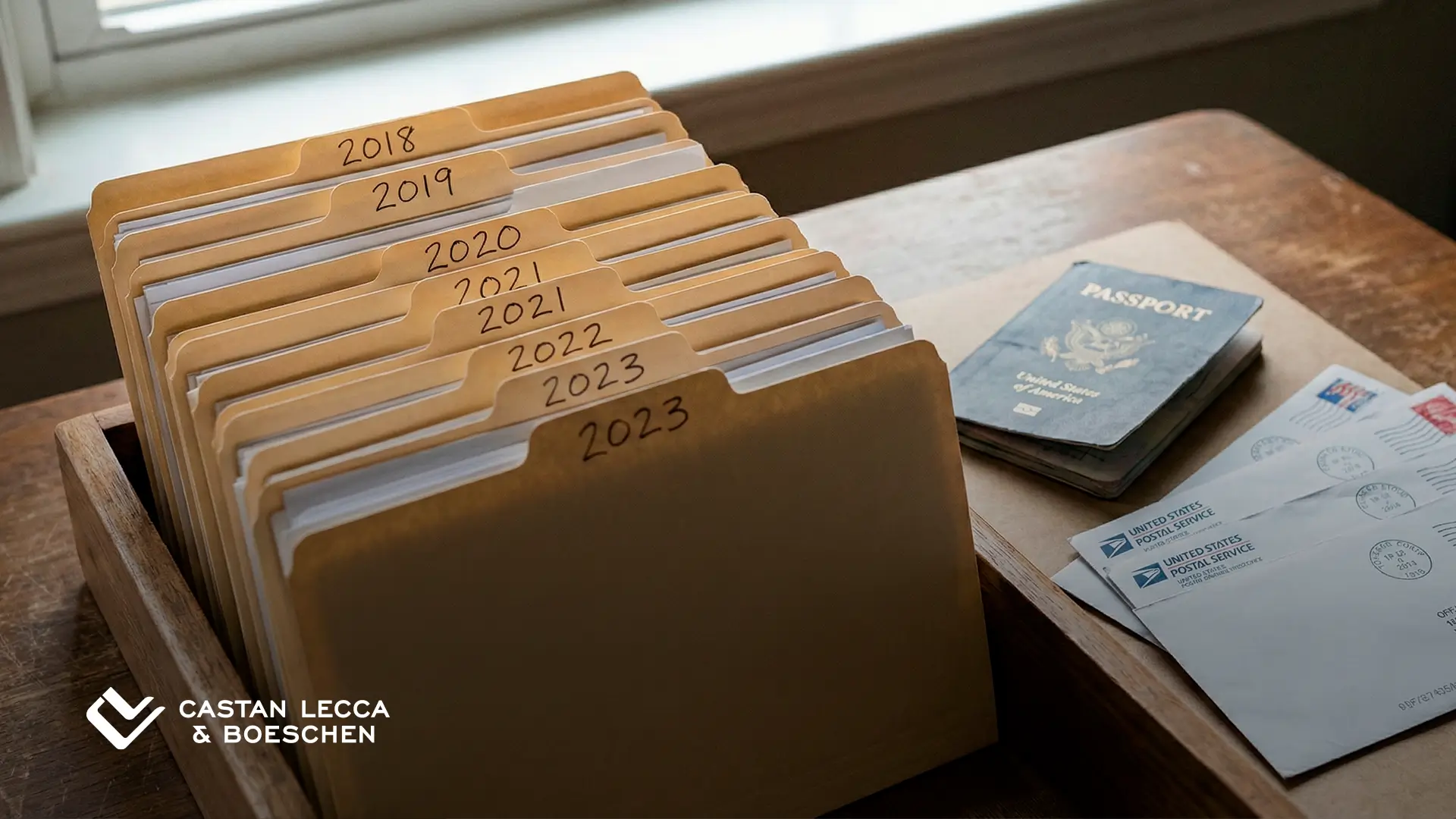
Folders organized by year next to a passport and mail to help with proving U.S. residency and 10 years continuous presence.

Proving 10 Years of U.S. Residency in 2026: A Senior Attorney’s Guide

Proving 10 Years of U.S. Residency in 2026: A Senior Attorney’s Guide
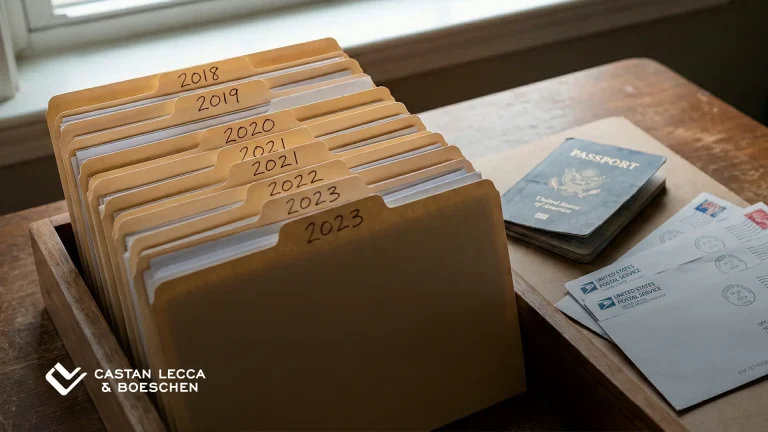
Folders organized by year next to a passport and mail to help with proving U.S. residency and 10 years continuous presence.

Living in the United States without permanent legal status is a journey of resilience, but it is also a journey filled with legal uncertainty. As we navigate the complexities of 2026, the stakes for our immigrant community have never been higher. Whether you are seeking a cancellation of removal in immigration court or pursuing a specific permit that requires proof of long term presence, the burden of proof rests entirely on your shoulders. At Castan, Lecca & Boeschen, we have spent over 30 years defending the rights of those who have built their lives here, and we know that a single missing receipt or an unexplained gap in your timeline can be the difference between staying with your family and being forced to leave the only home you know.

The legal standard for proving ten years of continuous physical presence is strict. It is not enough to simply tell a judge that you have been here since 2016. You must document your life month by month, year by year. In the current 2026 legal climate, USCIS and the Department of Justice have increased their scrutiny of evidence. They are looking for inconsistencies and “paper trails” that don’t align. This guide is designed to help you organize your history so that when you stand before an officer or a judge, your story is backed by an unbreakable wall of evidence.

The Standard of Continuous Presence in 2026

To qualify for many forms of relief, such as Non-LPR Cancellation of Removal, you must demonstrate that you have been physically present in the U.S. for at least ten years prior to the service of a Notice to Appear. This is governed by the “stop-time rule,” which effectively freezes your clock the moment the government initiates removal proceedings. If you have lived here for nine years and 364 days when you receive that notice, you may be ineligible for relief. This is why immediate legal intervention is critical.

Furthermore, “continuous” means you cannot have left the country for more than 90 days in a single trip or more than 180 days in total over that ten year period. In 2026, with advanced digital border tracking, the government has more tools than ever to verify your entries and exits. If you traveled back to your home country for a family emergency and stayed longer than expected, we need to address that gap strategically with secondary evidence or legal waivers where applicable.

Essential Financial and Employment Records

The strongest evidence of your life in America is your economic footprint. The government expects to see that you have contributed to the economy and maintained a stable residence. Tax returns are the gold standard. We recommend providing IRS tax transcripts rather than just your personal copies of Form 1040. Transcripts prove that the IRS actually received and processed your filing. If you have years where you did not file taxes, it is not too late to rectify that, but you must do so under the guidance of an attorney to avoid self incrimination regarding unauthorized employment.

Employment records are equally vital. In our 30 years of practice, we have found that pay stubs, W-2 forms, and even 1099 records provide a chronological map of your presence. For those who worked in more informal settings, such as domestic work or landscaping, we assist our clients in obtaining notarized letters from employers. These letters must be specific, including the dates of employment, your duties, and the employer’s contact information. In 2026, a generic letter saying “he worked for me for a long time” will likely be rejected for lack of foundation.

Housing and Utility Documentation

Lease agreements and utility bills used as USCIS residency documents and cancellation of removal evidence for immigration cases.

Your address history is a primary metric used by immigration officials. We advise all our clients to keep a dedicated “residency folder” containing every lease agreement they have signed over the last decade. If you lived with family members or friends and were not on the formal lease, we can use secondary evidence. This includes utility bills in your name, such as water, electricity, gas, or even internet service.

Even if you moved frequently, each address needs a corresponding piece of evidence. Bank statements are excellent for this purpose. A bank statement shows the date, your name, and your U.S. address. It also shows transactions made at local businesses, which further proves you were physically present in your community during those months. In an era where digital banking is the norm, downloading and printing these statements from 2016 through 2026 is one of the first tasks we assign to our clients.

Education and Healthcare Evidence

For families with children, school records are among the most persuasive documents available. If your children have attended school in the U.S. for the last ten years, their transcripts and enrollment letters serve as powerful circumstantial evidence of your own presence. It is highly unlikely that a parent would live in another country while their minor children are enrolled in a U.S. elementary school.

Medical records are another pillar of a strong case. This includes your own records and those of your family. Hospitalization records, immunization cards for children, and dental visit summaries provide clear, dated proof of presence. In 2026, medical privacy laws are strict, but as your legal representatives, we help you navigate the process of obtaining these records through proper HIPAA authorizations.

The 2026 Reality: Delays and Test Changes

If your residency goal is naturalization, you must be aware of the significant changes implemented recently. As of 2026, the Naturalization Civics Test has become more rigorous. Most applicants are now required to answer up to 20 questions instead of 10, needing 12 correct answers to pass. The item bank has expanded to 128 questions, covering more complex topics on federalism and the Constitution.

Processing times remain a challenge. As of February 2026, the median processing time for an I-485 Adjustment of Status is approximately 9 to 11 months, depending on the field office. However, we have seen cases take significantly longer due to backlogs. This is why we emphasize “front loading” your application. By submitting a perfect, document-heavy package at the start, you reduce the likelihood of a Request for Evidence (RFE), which can add six months or more to your wait time.

The Intersection of Injury and Immigration

Many of our clients come to us after a workplace injury or a car accident. This is where the unique expertise of Castan, Lecca & Boeschen becomes your greatest advantage. If you were injured on the job in Georgia, you have the same right to workers’ compensation as any other worker, regardless of your immigration status. However, an injury case can impact your immigration case.

For example, if you receive a workers’ compensation settlement, those funds can be used to prove you will not become a “public charge” in the future. Conversely, if an injury prevents you from working, we must document your medical treatment as proof that you are still present and contributing to your community in other ways. We often coordinate between our personal injury and immigration teams to ensure that a medical malpractice claim or a car accident lawsuit supports your long term goal of staying in the United States.

Why You Cannot Afford to Wait

A woman reviewing legal paperwork before consulting an immigration lawyer in Atlanta from the firm Castan Lecca & Boeschen.

In Georgia, legal deadlines are unforgiving. If you are injured in a car accident, you generally have only two years from the date of the wreck to file a lawsuit. If you are injured at work, you must notify your employer within 30 days. Missing these deadlines can cost you the financial recovery you need to support your family.

The same urgency applies to immigration. Laws and fees change rapidly. For instance, premium processing fees increased again on March 1, 2026, to reflect inflation. Waiting to file your residency application might not only mean higher costs but also the risk of new, more restrictive policies being enacted.

When you work with us, you are not just hiring a lawyer; you are joining a family that has served the Atlanta area for nearly thirty years. We offer free consultations at our Atlanta and Norcross locations and provide full services in Spanish to ensure you understand every step of the process. Do not let your ten years of hard work be erased by a lack of documentation. Call Castan, Lecca & Boeschen at 678-825-3611 today. We are here to help you move forward.

Sources and Verification

Part A: Internal Sources

Part B: Recent External Research

Department of State: Visa Bulletin and Backlogs: https://travel.state.gov/content/travel/en/legal/visa-law0/visa-bulletin.html

Does Divorce or Separation affect your Immigration Status?

Receiving a green card after getting married allows you to live freely in the United States with your spouse. However, your immigration status may change if you decide to have a divorce or separation.

A divorce or separation affects both you and your now ex-spouse. Depending on the time of the divorce, there may be a few things to consider: What will happen to your legal status, how do you secure your residency in the United States, and what should be your next steps? Since the situation affects how you progress through your divorce, you should be aware of the conditions of your legal residency in the United States. 

What are the differences between separation and divorce? 

In order for you to know exactly where your immigration status stands, you need to be sure that you and your spouse agree on whether you are having a divorce or a separation. 

For a divorce, a couple decides to completely sever their marital ties, and in the government’s eyes, you’re no longer together. 

In a separation, you are still legally married to your spouse, however, you both live separately. In Georgia, the law does not actually provide legal separation. Instead, there is a process called separate maintenance.

The purpose of this separation is to be apart from your spouse as you decide if the best course of action is filing for divorce or working things out in your relationship. You are neither married nor divorced during a separation. 

However, you still need to prove your marriage.

Before receiving your green card or lawful residence, you may have had to prove that you entered your marriage in good faith to ensure your union was sincere and not an effort to obtain residency or citizenship.

When it comes to your divorce, you need to create a statement showing why your marriage ended. This statement is later handed out in your divorce case. It is important to be completely transparent in your statement to prove the justified reasons to end your relationship. This can also verify the legitimacy of your marital union with your spouse.

There is no need to worry about your green card status when filing for divorce in Georgia, as you do not need to prove your relationship and immigration status. 

If you are unsure about how to proceed with your divorce or separation, having an exceptional immigration attorney on your side may help you take the proper steps to legally end your marriage.   

What are the effects on your green card after a divorce or separation?

Your green card status may change depending if you have a permanent green card or a conditional permanent green card

There is usually no impact on your immigration status for a permanent green card with a divorce or separation. Nonetheless, you must have a trusted attorney to guide you on the proper information you need to renew your green card by filing a Form I-90 to avoid any legal confusion. It typically takes about a month and a half to process your application.

The good thing about having a permanent or 10-year green card is that you will have no questions regarding your marital status. You would only have to submit a legal record with your updated last name. Ultimately, a divorce will not affect your legal status in Georgia.

On the other hand, with a conditional permanent green card, there may be issues if you get divorced. A conditional permanent green card is placed if your marriage is less than two years. After two years at the time of the adjudication, lawful permanent residency can be granted so you can have a permanent or 10-year green card.

However, if there are marital problems during your two-year conditional residence period, it may affect your immigration status, and it’s best and recommended to consult with an immigration attorney to evaluate your options.

In order to secure a permanent or 10-year green card, you will need an immigration attorney to successfully guide you in filing Form I-751, Removal of Conditions Petition. As an added motivator, divorce is the easiest avenue for a Removal of Conditions Petition as long as you are already divorced at the time of submitting your petition and are honest throughout your application.

In order to continue with your permanent or 10-year green card process, you need to file a waiver request. You will be issued a Request For Evidence (RFE) by the USCIS to show your finalized divorce.

With this RFE, you would need to show how your divorce or separation was finalized. Adding additional information may help your case, but it is best to have an experienced immigration attorney alongside you to make sure you add evidence that supports your divorce or separation.

What happens if you are in a legal separation?

If you are in a legal separation, removing the conditions of your green card may be difficult. The law needs to find that your marriage is a case of “extreme hardship” in order to continue processing your permanent green card. According to the USCIS, extreme hardships can be considered as family ties, health conditions, and economical issues. 

At Castan and Lecca, we are here to defend the community. If you have questions about your green card application or status after filing a divorce, do not hesitate to contact us for exceptional attorneys in the immigration field. You can also call us at 770-800-7000.


How Do I Apply For Naturalization?

Becoming a naturalized American citizen is a major, life-changing process. It spans many different components, so it’s important to be aware of all the details when undertaking this journey. 


Leading up to this point, you’ve worked hard to build a life for yourself and your family. You’ve sacrificed, fought hard, and you’ve succeeded. Perhaps you are currently a lawful permanent resident, but are seeking something more. Now is the time to enjoy all of the benefits that the United States has to offer.


Naturalization is the process by which a lawful permanent resident obtains naturalized citizenship. If you were born in a country outside of the United States, you may be eligible to become a “naturalized” citizen. 


When becoming a naturalized citizen as a lawful permanent resident, you must submit Form N-400 with all necessary documents. It also can include tests, fees, an interview, a biometric test, and a ceremony. 


In this latest blog post, we break down the requirements for the naturalization process. It isn’t easy, but staying informed of the process makes you aware of the challenges that may arise.  

Prove Age and Residence 

To become a naturalized citizen in the United States, you must prove your age and your residence. At the time of the filing, you must be at least 18 years old. The age of 18 is considered the threshold of adulthood in the United States. 


If you are embarking on the naturalization process as a lawful permanent resident (a green card holder), then you must have been living in the United States for the past three or five years. The exact length of time depends upon the naturalization category you belong to. 


According to the United States Citizenship and Immigration Services, you must “have lived for at least three months in a state or USCIS district having jurisdiction over your place of residence.”


An important factor to note is that you must also demonstrate that you have continuous and physical presence in the country. Be prepared to present evidence of your required time in the United States as well as your age. 

Demonstrate Your Morals and Loyalty

In addition to proving your age and residence, you must demonstrate morality and loyalty during the naturalization process. You must show that you are a person of “good moral character” and have been so for the time span of five years before the filing of your application. 


There are certain circumstances that permanently bar someone from achieving citizenship based upon moral character. These include committing murder, aggravated felony, genocide, or severe religious persecution, among others. 


In addition to proving good moral character, you must also demonstrate a certain level of attachment toward the ideals that the United States holds. This includes a loyalty to the US and a support of the ideals and principles of the United States Constitution, which is the supreme law of the land. 


Beyond this, you must also recite an Oath of Allegiance for the United States. This oath occurs during the last portion of the naturalization process at the naturalization ceremony

Demonstrate Your Knowledge 

When becoming a naturalized citizen, you must prepare to demonstrate knowledge of the United States, its government, and its history. In order to do so, you must take the Citizenship Test. This test largely focuses on civics and history. 


In addition to the citizenship civics test, you must also prove your knowledge of English by writing one of three sentences and reciting one of three sentences. 


It is important to note that if you are of a certain age and have lived in the US for a certain period of time, you may be exempt from the English test. It’s always best to consult with an experienced attorney so that you can plan accordingly. 


Fortunately, there are many different online resources that you can use to prepare for these tests. The United States Citizenship and Immigration Services provides some helpful tools to use (like practice tests) so that you can be confident in your knowledge on the testing day. 

Demonstrate Proof of Marriage to a US Citizen

If you choose to become a naturalized United States citizen through marriage to a US citizen, then you must show proof of that marriage. In addition to providing proof of age and residence, and morality and knowledge of the United States and the English language, you must also be prepared to provide documentation and discuss your marriage to prove its legitimacy. 

Demonstrate US Military Status 


If you have served in the United States military as a lawful permanent resident, you may choose to seek naturalized citizenship through that status. While the requirements for serving during peacetime differ from serving in wartime, you still have to complete the civics and English tests. To determine which category you fall into, see the Immigration and Naturalization Act, sections 328 & 329. You also have to complete the N-400 Form. 


In addition to that form, you must also complete Form N-426, Request for Certification of Military or Naval Service. Because the citizenship process through US military status can be complicated, especially if you are serving abroad, it’s best to seek guidance during this time. If you want to receive a free consultation of your case, contact Castan & Lecca today. 

Be the Child of a US Citizen 

In certain cases, you can seek naturalized citizenship merely through parentage. If your parent or parents are United States citizens, you may be eligible to become a citizen yourself. There are two ways that you can do this: either at birth or anytime before the age of 18. 


If you were born outside of the United States to one or more U.S. citizens and your parent(s) lived in the United States for a certain period of time, then you could choose to seek citizenship through this path. 


According to the USCIS, a “child” is a person who is the “genetic, legitimated or adopted child of a parent.” It also includes “the son or daughter of a non-genetic gestational US citizen mother” who is “recognized as the child’s legal parent.” 


In order to seek citizenship through parentage and you are in the United States, you must complete Form N-600. If you are outside of the United States, you must complete the N-600k form. 


While it may seem that applying for citizenship through parentage is a simple process, it can get complicated. Everyone’s case is different. Therefore, it’s important to know the facts and seek professional guidance before you submit your application. 

Starting the Naturalization Process


While the naturalization process may seem overwhelming at first, the outcome is always worth the time and effort. It’s important to keep in mind that you need to confirm your eligibility and then provide evidence of it and evidence of identity. 


You must also demonstrate your knowledge of the United States, its history, and its government, as well as knowledge of the English language. In addition to that, you must take an Oath of Allegiance to the United States and prove that you are of good moral character. 


Furthermore, you must also be aware of the details surrounding your unique circumstances. This can include marriage to a US citizen, serving in the US military, or being the child of a US citizen. These particular circumstances could require you to complete different forms or provide different evidence. 


Because the naturalization process can become complicated, it’s best to seek out professional legal assistance when you undertake this journey. At Castan & Lecca, we are here to help you achieve your dream of becoming an American citizen. Give us a call today to set up a free consultation of your case. 

Castan y Lecca Group

How to Obtain U.S. Citizenship Through Naturalization

Castan y Lecca Group
Many immigrants come to the United States with the dream of becoming an American citizen. However, this process can be quite complicated and stressful for those who do not know to go about the naturalization process.  To simplify the process, here are some tools to help you understand what you need to do to become a citizen.  First off, you should understand that the naturalization process can be accomplished in a few different ways:
(more…)
Castan y Lecca Group

Immigration waiver: definition, applicability and types

Castan y Lecca Group
The biggest problem immigrants face in the United States is deportation. For many good things you do in this country, a serious mistake can put you in the doorway. The service in charge of carrying out this process in the country is ICE. By definition, deportation is the process of removing an immigrant from the United States for failing to comply with immigration laws. The reasons why an immigrant can be detained and deported are diverse. Although the most obvious is having entered the country illegally, there are other reasons that put you in deportation:
(more…)
Castan y Lecca Group

Crimmigration: How to Avoid Immigration Problems in the Future

Castan y Lecca Group
The United States is often described as a land of dreams for immigrants. It’s talked about as if it is “the promised land,” a country where immigrants can get any job they want and achieve their wishes. This is why many non-citizens cross the border to America. They sacrifice everything, including leaving their loved ones behind, so that they can find a better future for their family.  As a non-citizen, it’s essential to know that making a wrong decision can immediately complicate your immigration status. Facing criminal charges puts your future in the U.S. at risk. Criminal charges can lead to immediate deportation and throw away all the effort you have made so far. You need to be extra careful when dealing with crimmigration cases.  A team of experienced criminal defense attorneys, like Castan & Lecca, can guide you and ensure the best possible outcome for your future in this country. Keep reading to learn everything you need to know about crimmigration cases.
(more…)

When applying for citizenship, an immigration lawyer is necessary. Know the reasons

Immigration legislation in the United States changes daily. We strongly encourage those who are not naturalized citizens to stay informed about immigration policies in the United States through credible news sources. Along with staying informed, it is critical for those looking to become United States citizens to understand the importance of adequate representation when pursuing citizenship or legal residence processes.
(more…)
Castan y Lecca Georgia Immigration Statics

Georgia Immigration Statistics

Castan y Lecca Georgia Immigration Statics
Did you know that immigrants account for more than 10% of Georgia’s population? And that percentage is rapidly increasing. As immigration attorneys, the topic of immigration is close to our hearts. In fact, for most of our lawyers and staff members, immigration is an integral part of our family story and personal heritage. That being said, we’re going to take a look at some facts on immigration in Georgia. These numbers are selected and compiled from the American Immigration Council’s comprehensive website.
(more…)
Castan y Lecca types of visas

Types of Visas You Can Apply For

Did you know that the U.S. offers approximately 185 different types of visas? These visas are primarily divided into immigrant and nonimmigrant visas, and within those two major categories are a wide variety of visa options for people seeking to visit or immigrate to the United States. If you or your loved ones are exploring visa options, we invite you to read this overview of visa types and to contact our office for further assistance. [Read more…]
(864)761-4141

Preston Moore

Attorney

Preston Moore is a trial attorney whose injured clients have seen more than $30 million in settlements and jury verdicts. An alumni of Georgetown University (B.A.) and Harvard Law School (J.D.), Preston started practicing law at a multinational firm in Atlanta where he represented large corporations in high-value lawsuits. From there, Preston joined a well-respected product liability practice in Atlanta where he focused on representing two key sorts of cases: workplace product injury matters and high-limit insurance litigation. Now, Preston serves his clients by providing high-quality, no-nonsense representation for those catastrophically injured by the negligence of others, whether by settlement (where his clients have obtained over $10 million in recoveries since January 2024) or trial (where his clients have earned over $10 million in jury verdicts since 2022). Preston is loved by Jesus and attends Calvary Baptist Church in Smyrna. He lives in Kennesaw, GA with his wife, Brooks (9), Tripp (3), Emma Kate (newborn), and his Pomeranian, Birdie.

Dustin Thompson

Attorney

Dustin Thompson was raised in rural Camilla, Georgia. Dustin graduated from Georgia Southern University majoring in political science and history. After graduation, Dustin obtained a law degree from Georgia State University College of Law in Atlanta. Before becoming a lawyer, Dustin worked a variety of jobs from a watermelon farm in Mitchell County to a policy think tank in Washington D.C. Dustin has practiced law almost exclusively in the workers’ compensation arena since 2014. For nearly a decade, he worked for a large defense firm in Georgia representing employers and insurers and gaining the invaluable experience and knowledge of how insurers defend claims. In 2023, Dustin joined the firm to use his expertise and litigation skills to help individuals who have been injured as a result of work accidents and third-party negligence.  Dustin has been repeatedly recognized by Best Lawyers: “Ones to Watch” in the practice of workers’ compensation. Outside of work, Dustin enjoys traveling, hunting, and attending sporting events. He and his family are active in Buckhead Church.

MICHAEL BOESCHEN

Attorney

Michael Boeschen (Mike) was born in Wichita, KS and raised in Chattanooga, TN. Mike graduated from The McCallie School and went on to study history, Spanish, and Latin American Studies at Southern Methodist University in Dallas, TX. After graduation, he went on to pursue a law degree from the University Of Georgia School Of Law. During law school, Mike participated in the Legal Aid Clinic, assisting in the defense of indigent criminal defendants. Mike has been licensed to practice law in Georgia since 2002 and his main practice area consists of representing injured workers as they navigate through the Georgia workers’ compensation system. Mike is also fluent in Spanish. In his spare time Mike enjoys following soccer, cooking, and spending time with his wife and two young daughters. Mike and his family are parishioners of the Holy Spirit Catholic Church in Sandy Springs, GA

CHRISTIAN PECONE

Attorney

ED DENKER

Attorney

Edward Denker was born in Philadelphia, PA but has made Georgia his home since 1999. He graduated from the Pennsylvania State University with a Bachelor’s degree in liberal arts. He then earned his Juris Doctorate from the University of Georgia. Edward spent his first years in practice representing clients in personal injury and wrongful death claims. He then spent more than a decade honing his litigation skills representing employers and insurers in workers’ compensation claims, where he gained immense experience and knowledge of how insurers defend those claims. In 2017, Edward returned to his passion of representing people who have been injured at work or through the negligence of others. When he isn’t working, Edward enjoys spending time with his wife and their two children. He is also an avid sports fan, and enjoys cooking and travel

ILIANA DOBREV

Attorney

Iliana Dobrev was born in Bulgaria. After high school, she immigrated to the United States to study law. She graduated magna cum laude from Georgia State University with a Bachelor’s in political science concentrating on pre-law and minoring in Spanish. In 2015, she graduated from Georgia State University College of Law. While in law school, Iliana completed a Graduate Research Assistantship in Labor and Employment Law and Employment Discrimination and two externships in Immigration Law. As an immigrant herself, Iliana is passionate about advocating for and defending immigrants. She is delighted to help families stay together and pursue the American dream. Iliana is a member of the American Immigration Lawyers Association and worked in both a fellowship and a firm specializing in immigration law. Iliana is fluent in Bulgarian and Spanish

AREAS OF PRACTICE 
  • Immigration
  • Misdemeanor Criminal Defense
  • Accidents at Work and Personal Injury
  • Guardian Ad Litem
  • Uncontested Divorce
  •  
BAR ADMISSIONS
  • State of Georgia, November 2015
  • Supreme Court of Georgia, November 2015
  • Executive Office of Immigration Review (EOIR), 2016
  • U.S. District Court for the Northern District of GA, May 2021


EDUCATION
  • J.D., Georgia State University College of Law, 2015
    • GRA
  • B.A., Georgia State University, Bachelors of Arts, Political Science/Pre-Law, 2011
    • Minor in Spanish
    • Magna Cum Laude


CERTIFICATIONS AND SPECIAL DESIGNATIONS
  • Health Law Certification, Georgia State College of Law, May 2015
  • Guardian ad Litem, Atlanta Volunteer Lawyers Foundation, July 2025


PRESENTAIONS AND SPEAKING ENGAGEMENTS 
  • Inadmissibility And Deportability, 2022 Georgia Alabama Aila Chapter Annual Conference “Lawyers At Work: Building A Stronger Immigration Bar”, CLE Speaker, March, 2022.
  • Congressional Ambassador, AILA National Day of Action, Washington, D.C. March, 2024.
  • Panel on Migrant Justice and Undocumented Youth Struggles, Georgia State University College of Law, 2021.


ORGANIZATIONS
  • State Bar of Georgia
  • Cobb County Bar Association
  • AILA, American Immigration Lawyers Association
  • Georgia Democracy Taskforce
castan&lecca-iliana-bio

KEN THAXTON

Attorney

Ken Thaxton was born and raised in Roberta, GA. When Ken was a child, his father started a trucking business, which Ken ultimately spent over ten years working with through his late teens and twenties. Ken graduated from Houston County High School in Warner Robins, GA in 2001 with a 4.0 GPA. He then studied Business and Information Technology at Macon State College, ultimately graduating with a 4.0 GPA in 2004. After graduation, Ken continued to work with his father’s trucking company, and in late 2005, Ken and his father started an aircraft charter company, Southern Jet, Inc., under Part 135 of the Federal Aviation Regulations. Ken served as President of Southern Jet from 2006 until 2010, when he and his father sold the company. Ken is a Commercially Licensed Instrument, Multi-Engine Pilot. While serving as President of Southern Jet, Ken started Law School at the University of Georgia School of Law in 2009. Ken focused primarily on business and civil law, including Workers’ Compensation, while at UGA. He graduated Cum Laude and in the top 25% of his class from UGA Law in 2012. Ken is a licensed to practice law in the State of Georgia, and he is also a licensed neutral (mediator) in the State of Georgia. Ken represents small businesses in transactional matters and business conflicts, and he also represents injured workers and Plaintiffs injured in cases of negligence. During his spare time, Ken enjoys swimming, cycling, sporting clays, and fishing. He also does charity work with a national scholarship fund
castan&lecca-ken-bio

ALEXANDER LECCA

Attorney

Alexander Lecca (Alex) was born in Miami, Florida to immigrant parents from Cuba and Peru. Alex graduated from Coral Gables High School, where he was a recipient of the Elsa Glazer Award (given to students who graduate with a 3.5 GPA and above). He went on to study marketing at the University of Miami School of Business Administration. At the University of Miami he was also a member of the Pi Kappa Alpha fraternity. After graduation, he went on to pursue a law degree from St. Thomas University School of Law. In law school, Alex received several book awards and graduated Cum Laude. During law school Alex clerked for the Honorable Beth Bloom, had an internship with the Miami-Dade County Public Defender’s office, and clerked for a prestigious litigation law firm. Alex is licensed to practice law in both Georgia and Florida and handles workers’ compensation and personal injury cases. He is also a registered mediator with the Georgia Office of Dispute Resolution. Alex is also fluent in Spanish. During his spare time, Alex enjoys outdoor activities with his wife and four children. He also helps coach his children’s baseball, football, basketball, and soccer teams. Alex and his family are parishioners of St. Catherine of Siena Catholic Church

DANIEL CASTAN 

Attorney

Dan Castan is a senior partner at Castan and Lecca, PC in Buckhead and represents injured workers before the State Board of Workers’ Compensation and plaintiffs in State and Superior Courts of Georgia for injuries suffered in accidents. Dan litigated one of the seminal claims securing the rights of undocumented workers to receive Workers’ Compensation benefits in the state of Georgia when injured in the case of Wet Walls, Inc. vs. Ledesma. Dan has successfully fought and settled multi million dollar cases. He was born and raised in Newark, New Jersey to immigrant parents from Cuba. He received a Bachelor of Arts degree from Boston College and received his Juris Doctor from The Washington College of Law at The American University in Washington D.C.  Dan was admitted to the Georgia Bar in November, 1993.  He is an active member of the Hispanic Chamber of Commerce, Georgia Trial Lawyers Association, Atlanta Bar Association and the Workers’ Compensation Section of the State Bar of Georgia. Dan is a founding member and Director of the Latino Victory Fund Georgia and serves on the Board of The Latin American Association. Dan has been dedicated to getting Latinos elected to local, state and Federal offices in Georgia. He has been a Big Brother through Big Brothers and Sisters of Metro Atlanta and a mentor through The Latin American Association’s mentor/mentee program. Dan is married with two children.